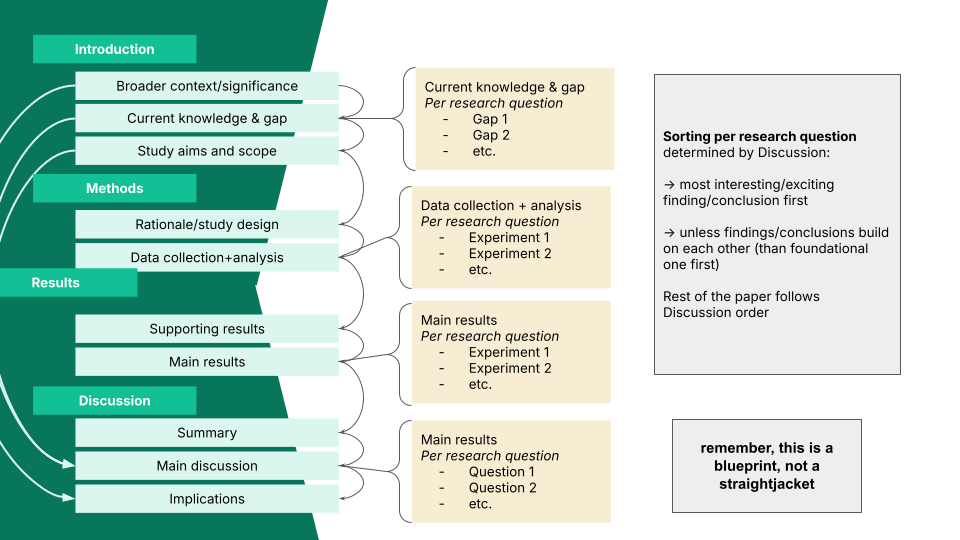
Function: presenting the right information in the right place
Introduction
A good introduction argues why the research matters.
→ See also: Introduction logic
Broader context
Establishes the problem that needs solving (societal/scientific significance).
Significance can be societal or scientific
Societal significance often addresses an issues in society. Scientific significance addresses an ‘issue’ in science: there is a major knowledge gap.
Current state of knowledge & gaps
Justifies the study aims and scope by explaining what is known, what is not known but important to know.
Gaps don't exist
A gap is difficult to describe because it’s something that doesn’t exist. Hence, why it is important to describe the current state of knowledge. This describes the ‘surroundings’ of the gap, so you can make the gap visible.
Study aims & scope
The study aims state clear, specific research question(s) that directly address the knowledge gap. This establishes a contract: you promise to answer a specific question. The scope creates boundaries around that question.
Methods
Methods establish explaining how the research questions were answered, and why that was a good way to answer them.
Rationale
This justifies the study/experimental design.
Procedure
Explains how exactly data were collected and analysed.
Check your field
Rationale and procedures may appear as separate subsections or woven together — depends on the journal/field.
Results
The Results section presents your findings using figures, tables, and other information.
Supporting findings
Validate the main findings. Common examples are:
- Sample characteristics,
- descriptive statistics for key variables (mean, median, standard deviations), or
- environmental conditions (temperature, pH).
Check your field
Supporting findings are sometimes included in the Methods section instead — depends on the journal/field.
Main findings
Interprets the data (not the results!) by identifying patterns, trends, and relationships that answer the research questions.
Discussion
Interpreting of the results and answers the research questions. In other words, delivers on the promise that was made in the Introduction aims & scope, and must address the knowledge gaps.
Summary
Reminds the reader of what you did, what you found, and shows your most interesting conclusions.
Check your field
Summary is not always included — depends on the journal/field.
Main discussion
Addresses the research questions by drawing conclusions, using the results, literature, assumptions, and limitations. → See: Discussion arguments
Study limitations at research question or entire study level?
Study limitations can also be a separate subsection — depends on what works for your paper.
Implications
The implications link your study back to the broader context, highlight the study contributions, and suggest future directions or potential applications.
Many names
The Implications section is sometimes labelled “Conclusions and Implications,” “Concluding Remarks,” “Outlook,” or simply “Conclusions,” depending on the journal and the specifics of your research.
Aligning structure across sections
Introduce and discuss your research questions consistently, using the same order across the Introduction, Methods, Results, and Discussion. This makes the paper easier to follow and lets readers quickly map questions to findings and interpretation.
The Discussion section typically sets the order, with the other sections following it.
There are two common approaches:
- From most to least exciting: Present the research questions in the order of the most interesting or impactful findings and conclusions first.
- Sequential/stepwise: If the questions build on one another, start with the simpler or more basic questions, then show how later analyses build on them.
These two approaches can also be mixed.